The Peptide Stack, Deconstructed
Every compound should have one reason to be there, and a way to prove it belongs.
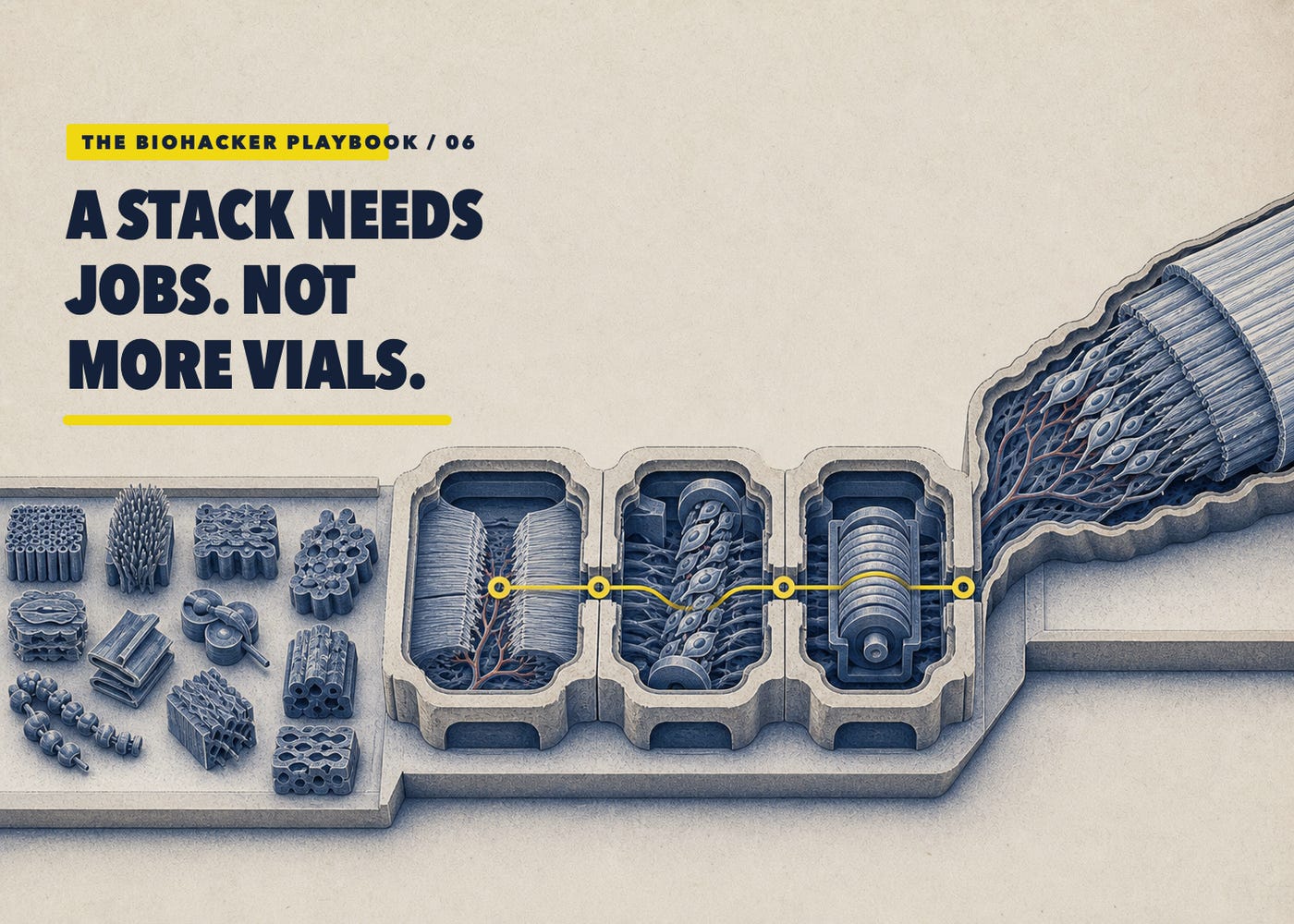
My approach to stacking changed when I stopped asking, “What else can I add?” Now I ask, “What is the least amount I need to do the job well?” That question cuts variables and makes the result easier to read. Most important, it turns a shelf of interesting compounds into a protocol.
I love peptides. I use selected tools myself, recommend specific options to clients, and still make every compound earn a clear reason to be there. Six good compounds don’t automatically make one good stack. A stack should be a deliberate protocol, not a collection.
The goal sets the rules
People usually start with the wrong question: what is the best peptide? There is no useful answer without a goal.
BPC-157 can be one of my favorite research peptides and still be irrelevant when the question is appetite control, hormones, sleep apnea, or product identity.
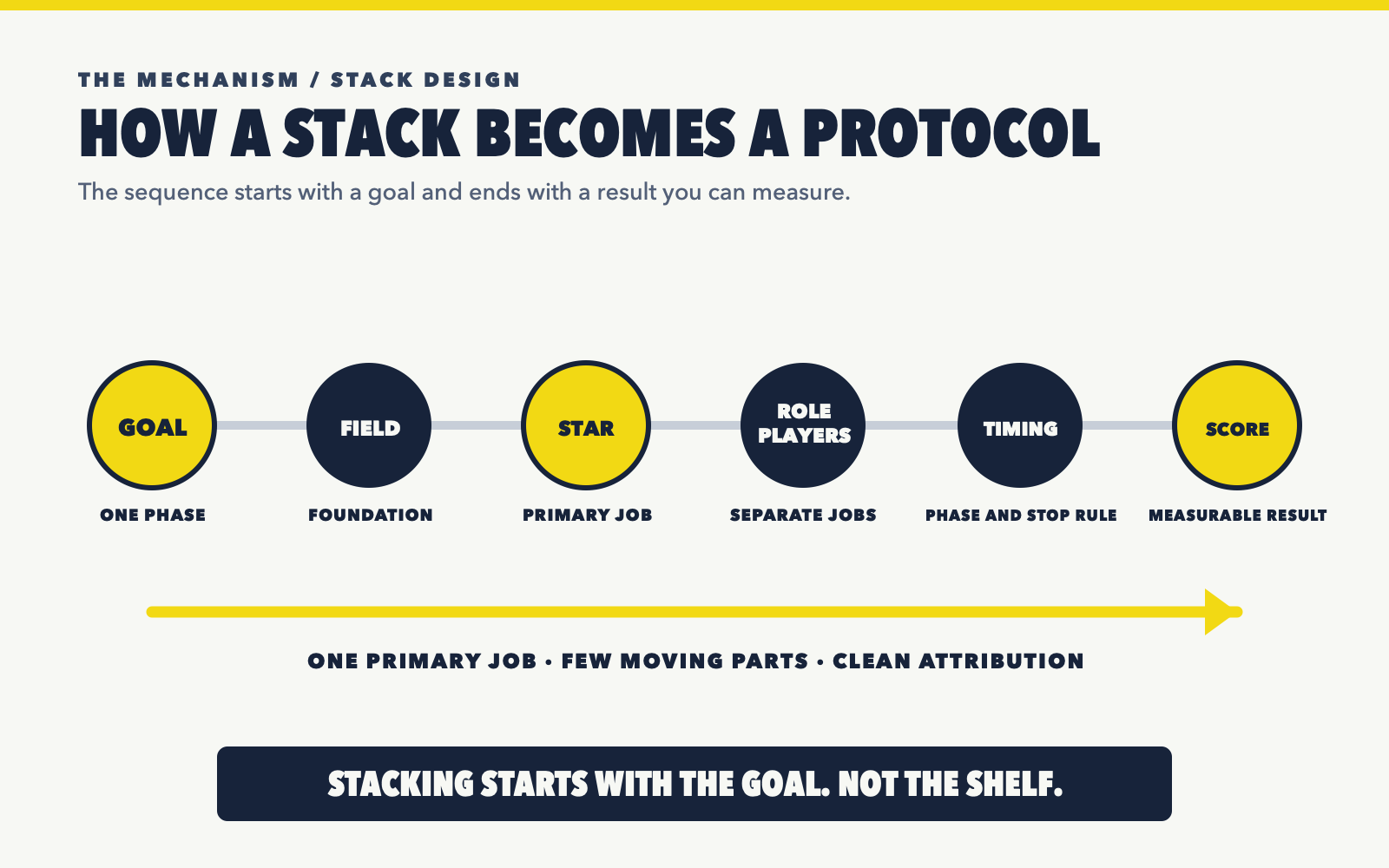
The goal makes the decisions. First I decide whether the phase is about repair, body composition, energy, sleep, skin, or hormones, then I pick one primary outcome.
Once the goal is clear, I look at bloodwork, sleep, stress, movement, nutrition, training, hormones, medications, injury status, previous response, and product legitimacy.
Even a great peptide and a great plan can be wrong for the person or the timing.
That is why the goal goes first.
The foundation gives the tools something to work with
Peptides carry instructions, and the body still needs the machinery to do the work. A perfect instruction still fails when the system lacks sleep, protein, energy, rehabilitation, or reliable material.
High stress, poor sleep, no movement, low protein, uncontrolled medical problems, and bad sourcing give those instructions very little to work with.
Peptides can support a process. They do not organize the entire system by themselves.
Here is the mechanism in plain English.
A peptide or small molecule can bind a receptor, block an enzyme, change a fuel-sensing pathway, or alter how strongly a message is delivered. That first contact is only the beginning. The instruction still has to move through proteins inside the cell, reach the right genes or enzymes, and be executed using oxygen, amino acids, minerals, hormones, and ATP.
Different compounds can begin at different doors and still arrive in the same hallway. Others can pull the system in different directions. Some effects are short. Others remain active long after the person has stopped thinking about them.
A mechanism list becomes a stack only after I decide what comes first, which tools support it, how long each one remains active, and whether the body has the raw materials to respond.
This foundation is how I get more from the compounds I use.
I want the foundation strong enough that when we ask the body to repair tissue, control appetite, change growth-hormone activity, improve mitochondrial function, or recover, it has a chance to respond.
Pick the first lever
Most good stacks center on one outcome. I start with the compound most directly connected to it, then give that compound the cleanest measurements.
In my personal repair framework, BPC-157 carries the lead research question. I use it frequently, have had a strong experience with oral BPC, and think about its role inside the whole recovery plan.
In an appetite and metabolic-control context, a GLP-1 tool may come first. It can reduce constant hunger and cravings and make the nutrition plan easier to execute.
In a mitochondrial context, the primary lever might be NAD support, MOTS-c, or another tool chosen around the actual bottleneck.
The first lever is the one most likely to move that phase, regardless of what the internet calls best.
Only add what solves a second problem
A useful second tool should remove a constraint the first one cannot. This is where stack design becomes useful.
In my personal research framework, BPC-157 and TB-500 handle different parts of the repair conversation. The pairing interests me mechanistically, but direct human evidence for the combination remains limited.
For a GLP-1 phase, the support plan begins with resistance training, protein, hydration, digestion, sleep, and hormonal context. Recovery and mitochondrial compounds belong in separate evidence conversations. I only bring one into the plan when I can explain exactly why it is there.
For my mitochondrial approach, I have publicly described NAD, MOTS-c, and 5-amino-1MQ together. NAD supports the cellular handoff and recycling system. MOTS-c helps the cell respond to changing fuel conditions. 5-amino-1MQ targets another metabolic lever. I also use urolithin A as part of the cleanup side of mitochondrial support.
That is the standard: one objective, separate reasons.
If two compounds are trying to do the same thing, I want a very good reason for the overlap.
The counterintuitive rule: more compounds can make the experiment weaker
People assume a bigger stack is a stronger stack.
Sometimes it only adds variables.
When several compounds enter together, attribution, side-effect tracing, and protocol adjustment all get harder. We don’t know which tool caused the result, every new variable becomes a suspect, and changing one piece can alter the whole picture.
The biology may also overlap downstream even when the labels sound different. Two tools can lean on the same receptor family, energy-sensing pathway, or hormonal axis. That doesn’t prove the tools work better together. It can create redundancy, more side effects, or a result that’s harder to interpret.
The smartest stack I can build is the smallest coordinated group that can move the goal while still letting me tell what each tool contributed.
Timing changes the answer
I don’t treat compounds like furniture that can sit on a shelf and somehow deliver a benefit. Timing has to match the biology and the rest of the plan.
Timing and cycling depend on the compound, evidence, exposure, and clinical or research framework. Those details belong in the full guide because a universal internet calendar cannot answer them.
I still think in phases. Every model needs a stop rule tied to the evidence, exposure, monitoring plan, and whether the original goal still exists. A repair phase can’t become permission to keep abusing an injury, and a fat-loss phase still needs a maintenance destination.
Define the result before the stack
If the result cannot be defined, it cannot be managed. The measurements depend on the goal.
For repair:
Range of motion
Pain under a repeatable movement
Swelling
Tolerance to load
Training function
Next-day response
For body composition:
Waist and body-composition trend
Strength
Protein consistency
Constant hunger and cravings
Energy and recovery
Digestion
For mitochondrial support:
Consistent energy ratings
Training output
Afternoon crash frequency
Recovery between sessions
Sleep quality
Relevant clinician-selected labs
The measurements have to be chosen before the experiment. Otherwise the mind rewrites the goal to match whatever happened.
How I use this with clients
With clients, I write down the goal, the starting point, what is missing from the foundation, the smallest useful intervention, and how we will judge it. If those five answers are fuzzy, adding another vial will not make the plan clearer.
Then we choose the first lever and only the additional tools that solve a named constraint.
I want fewer simultaneous changes, especially at the start. When someone begins five compounds on the same day, positive and negative results become guesses.
I get the basics in place, introduce one main variable, watch what happens, then add support only when the result gives me a reason.
The same logic applies to any crowded stack. Don’t automatically add. Removing two variables may be the cleanest way to see whether the remaining one is doing anything.
The mistakes I see people make
Chasing six primary goals. If repair, fat loss, cognition, sleep, hormones, and longevity all come first, nothing comes first. Pick the phase.
Stacking names instead of reasons. Two popular compounds do not become complementary because they appear in the same social post. I want to know what each one targets, what I expect it to change, how long it acts, and how I will judge it.
Changing every variable at once. Establish the baseline, introduce the lead variable, observe, then add support when a real constraint appears.
Borrowing somebody else’s calendar. “Eight weeks on, four weeks off” isn’t a universal law. A short-acting compound and a long-acting compound do not become equivalent because they share a day on the schedule.
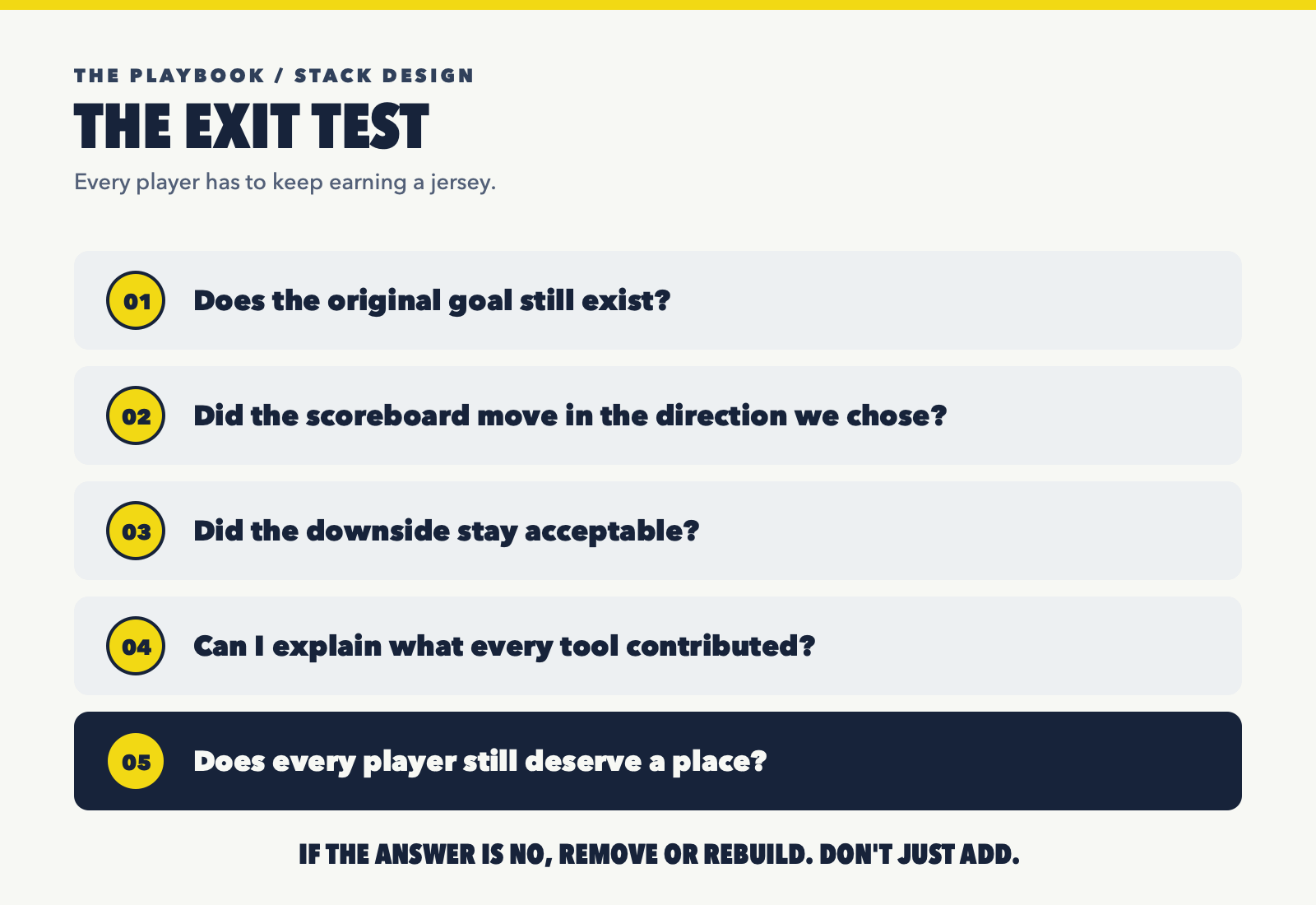
Running without a stop test. Every phase needs a point where I ask whether the original goal still exists, the measurements moved, the downside stayed acceptable, and every tool still deserves a place. A compound also cannot replace the protein, sleep, rehabilitation, hormones, or energy required to carry out the message.
What this looks like in real stacks
For repair research, I may put BPC-157 first and use TB-500 for a different mechanistic reason. Source verification and a clearly defined research model come before either one. I watch the repeatable things: range of motion, response to load, swelling, training function, and next-day response. I use BPC orally and subcutaneously, but the sourcing, dosing, timing, and protocols belong in Catalyst and Skool, not in a public article.
For body composition, a clinician-prescribed GLP-1 may handle appetite while training, protein, digestion, hydration, sleep, and hormone context protect the result. I am watching waist, strength, protein consistency, hunger, energy, recovery, digestion, and the labs the clinician selects. If the person is losing weight while losing the ability to train, I do not call that a clean win.
My mitochondrial stack is different again. I use NAD, MOTS-c, 5-amino-1MQ, and urolithin A for different parts of the same objective. SS-31 and methylene blue remain separate decisions, not automatic additions. Energy, output, crashes, sleep, and recovery tell me more than the size of the stack.
The logic stays simple. Pick the goal, fix the foundation, and add only what the result says the phase still needs.
If the evidence level matters to you
Most exact stacks have never been tested together. Researchers may study one drug or peptide under controlled conditions, but they rarely study my combination, timing, training plan, diet, hormone status, and source material. That makes it an N of 1 experiment, and I run it that way. I want to know the uncertainty, respect the downside, verify the source, and add variables slowly enough to learn something.
If you need a randomized human trial on the exact stack before considering it, most biohacking stacks will never qualify.
That is your call.
My call is to use the evidence we have, the mechanisms we understand, my own experience, and measurements that can prove me wrong.
The collection trap
Buying compounds can feel like progress even when all I have done is shop. The collection trap begins when every new vial arrives with a new goal. Once repair, fat loss, cognition, and longevity compete inside one stack, I can no longer tell which compound did what. I love these tools too much to use them that badly, so I give the protocol one objective, finish the phase, learn from it, and then decide what deserves attention next.
Bottom line
I use peptides, recommend selected tools, and keep only the combinations I can explain. My most important rule is to use the least amount I need to do the job well. That keeps the protocol focused and lets me tell what worked.
For the complete stack guide, including sourcing, dosing, timing, cycling, and protocol design, use Catalyst or join my Optimize & Thrive Skool community. That is where I keep the full implementation.
Stay on the edge,
Barry the Biohacker
Barry’s public protocol receipts
Educational content only. These are Barry’s personal frameworks and mechanism-based examples, not individualized medical advice. Research compounds vary in quality, evidence, regulatory status, and risk. Prescription medicines and hormone treatment require appropriate licensed clinical care.