Reading A COA Without Getting Fooled
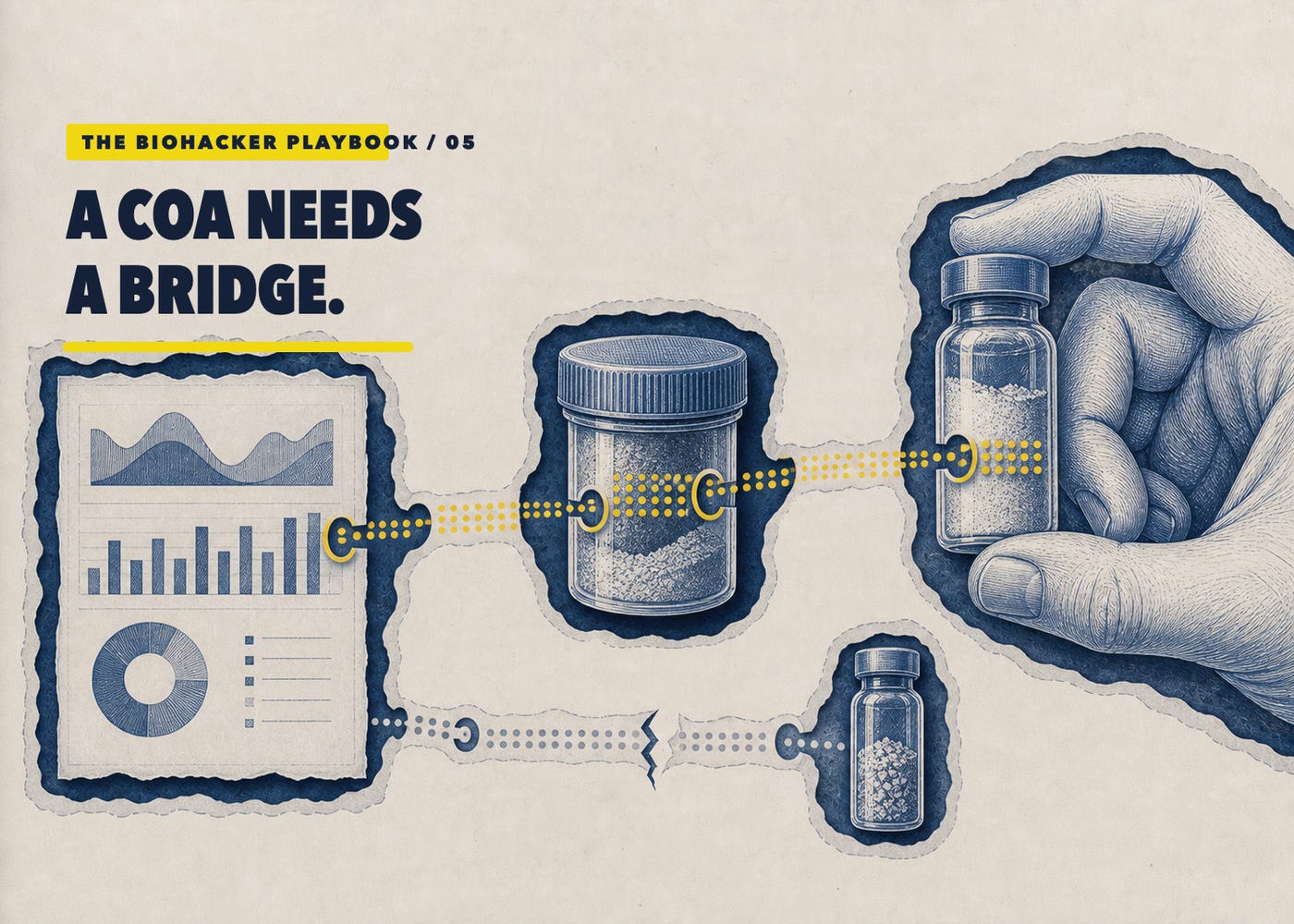
A COA only becomes useful when the report, tested sample, and vial in your hand connect.
After years of using peptides, the lesson I wish somebody had hammered into me on day one is simple: the source matters more than the compound. People will debate BPC, TB-500, tesamorelin, or MOTS-c for weeks, then buy from a vendor that can’t prove what’s in the vial. At that point, the protocol argument is useless.
A perfect protocol cannot rescue the wrong molecule, the wrong amount, contaminated material, bad handling, or a vial that has nothing to do with the PDF attached to the product page.
Most people look to the COA for reassurance, which is exactly why weak vendors use it to manufacture trust.
A COA is a receipt
A COA is a receipt for one submitted sample. That’s it. It doesn’t approve the product, prove every vial matches, or say the material belongs in a person. Sterility and endotoxin need their own valid tests.
Think of a COA like a receipt for one inspected car.
The receipt can show that a specific car had the correct engine and passed certain checks on a certain date. It can’t prove every car has the same engine, that the brakes were tested, or that the dealer handed you the inspected car.
The chain from sample to report to your lot is the whole game.
Identity is the name on the jersey
The first question is whether the material is the compound on the label.
Identity testing asks, “Who is this?”
Mass spectrometry is one tool a lab can use. The expected molecule has a characteristic mass. Other analytical methods may add confirmation.
Picture a player walking onto the court wearing number 23. The jersey says who he is supposed to be. Identity testing checks the face.
If a report shows only a purity percentage and never establishes identity, the lab may be telling you that the sample contains a lot of something clean. That still doesn’t prove the material is what you ordered.
Start there.
Purity is the roster
Purity asks how much of the detected material appears to be the target compared with other detectable components under the method used.
High-performance liquid chromatography, often shortened to HPLC, separates material as it moves through a column. Different components tend to appear as different peaks on a chromatogram.
The main peak is usually the target. Smaller peaks may represent related substances, degradation products, or other impurities.
But the machine is not taking a vote on everything that could possibly be in the vial.
The number depends on the method, detector, sample preparation, and reference standard. It compares what that method detected under those conditions. It doesn’t tell you the vial’s total weight, every possible contaminant, or whether the sample is sterile.
That distinction matters. A large target peak can support purity while leaving quantity unanswered. The same chromatogram cannot suddenly become an identity test, a fill-weight test, a sterility test, and an endotoxin test because the number looks impressive.
Identity confirms the molecule. Purity shows how much of the detected material belongs to the target instead of related impurities.
A “99 percent purity” line without the chromatogram, method, sample details, and lab context is weak proof. It is a headline without the article.
Purity also doesn’t tell you the total amount in the vial.
Quantity is whether you got what you paid for
A sample can be highly pure and still be underfilled.
If a vial is labeled 10 milligrams, purity alone doesn’t establish that 10 milligrams are present. Quantity or content testing addresses that separate question.
This is one of the easiest traps in peptide sourcing.
A vendor shows 99-plus-percent purity. The buyer assumes the vial contains the labeled amount. Those are different claims.
The simple breakdown is:
Identity confirms the compound.
Purity compares the intended compound with detected related impurities.
Quantity measures how much intended compound is in the tested sample.
Identity, purity, and quantity are three separate questions, and each needs its own receipt.
Sterility and endotoxin are different again
A clean-looking chromatogram says nothing about microorganisms.
Sterility testing looks for viable microbial contamination under defined conditions. Endotoxin testing looks for bacterial components that can trigger a strong inflammatory response even when living bacteria are not present.
They are separate tests because they answer separate questions.
This is where a single purity number becomes dangerous theater. Chemistry can look excellent while microbiological quality remains unknown.
The report needs to show what was tested, the method, the result, and enough sample information to connect the result to the lot.
If the test isn’t listed, don’t mentally award the product a pass.
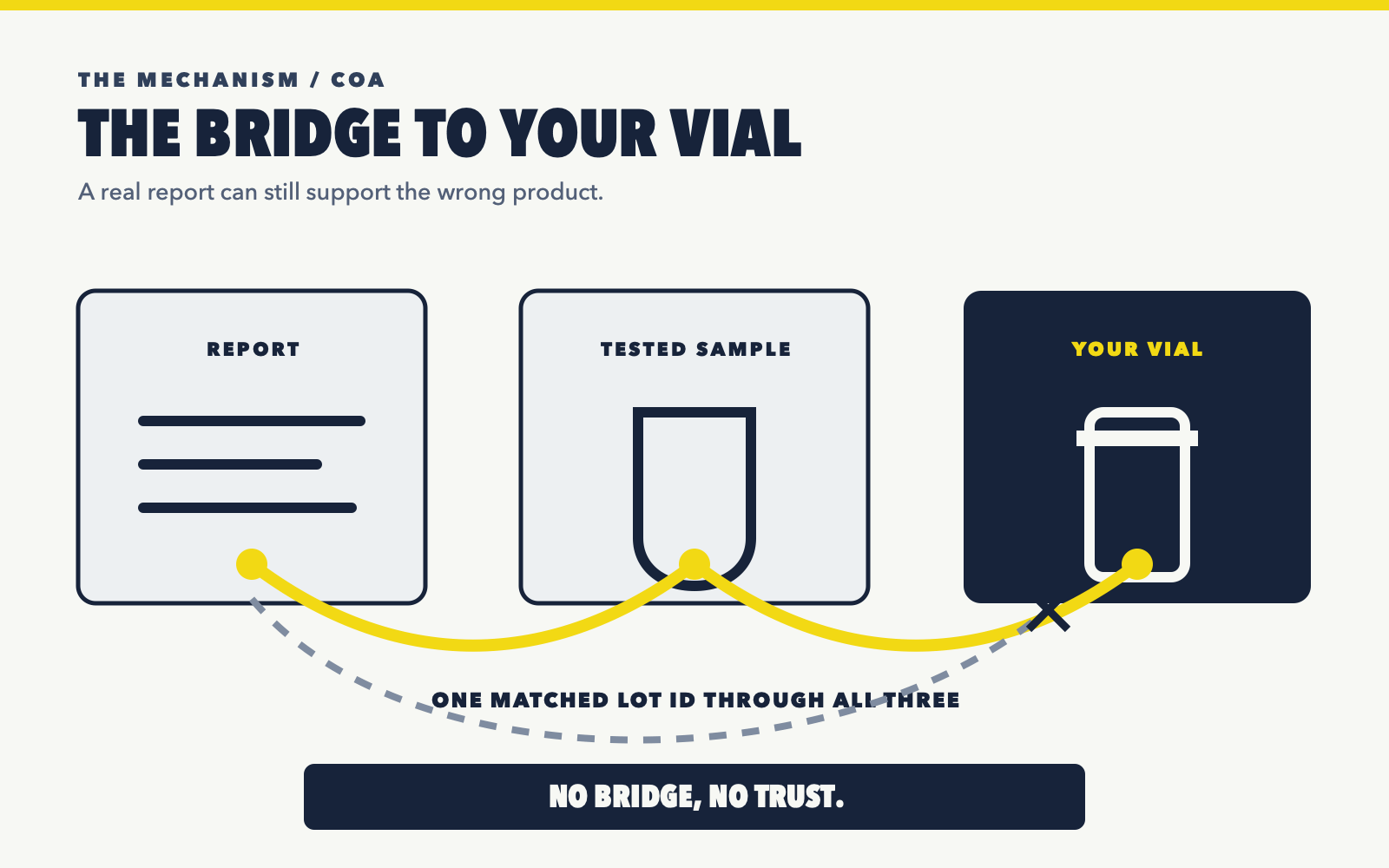
The lot number is the bridge
The biggest loophole in the COA world is simple.
A real report can be attached to the wrong batch.
The PDF, laboratory, and tested sample may all be legitimate, but none of that proves your vial came from the material they tested.
That is why I look for a matching lot or batch identifier across the vial, vendor record, and laboratory report.
The dates should make sense too. A report dated before the batch existed is a problem. A report recycled for years across new inventory is not lot-specific proof. A sample name that never identifies the vendor or lot leaves a large hole in the chain.
The report needs a bridge to your vial.
Without that bridge, you have a nice laboratory result for somebody’s sample.
The most convincing fake may be a real report
People picture a fake COA as a sloppy Photoshop job. Those exist, but a vendor does not have to fabricate the whole document. A genuine report for a genuine sample can be reused on a later batch, attached to another product, or displayed without any reliable link to current inventory.
A real lab can verify a real report number and show excellent chemistry for the tested sample while the claim still fails at the bridge.
That is why I care more about lot linkage than graphic design. A beautiful PDF is presentation. A matched sample identifier, lot number, test date, method, and independent verification path create evidence.
There is a second bridge people miss too: time and handling. A COA is a snapshot of the sample when it was tested. It does not prove that every vial was filled uniformly, stored correctly, shipped within appropriate conditions, or protected from compound-specific degradation after the test.
The receipt can be honest and still be incomplete.
My COA checklist
Here is the order I use.
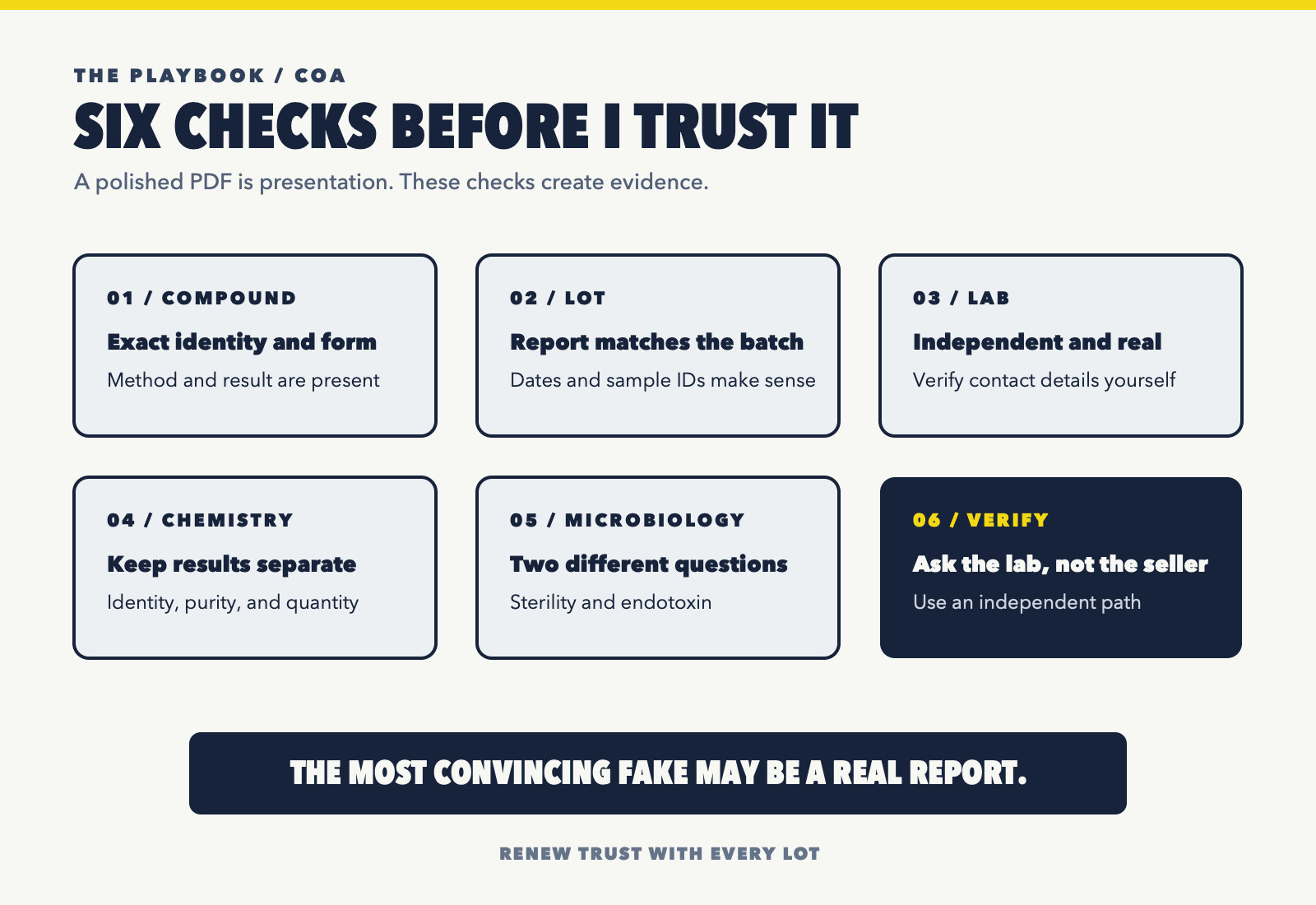
Match the compound: the report names the exact compound and form being sold.
Match the lot: the lot or batch on the report matches the product record and vial where applicable.
Name the lab: the report identifies a real, independent laboratory with verifiable contact information.
Check the sample: sample identifiers, receipt date, test date, and report date are present and logical.
Check identity: the report includes an appropriate identity method and result.
Check purity: the report includes the method and chromatogram alongside the percentage.
Check quantity: if content is claimed, an appropriate quantitative result supports it.
Check microbiology: sterility and endotoxin appear as separate valid tests when those claims are being made.
Read the method and units: “Pass” without the specification, result, or unit can hide a lot.
Verify the report: use the lab’s verification system or contact the lab through independently found information.
That final step catches more problems than people expect.
Do not use the phone number printed on a suspicious PDF as your only verification path. Find the laboratory’s official site independently. Ask whether the report number exists and whether the details match.
The mistakes I see people make
Mistake one: treating purity as proof
Start there. A high purity number for the wrong molecule or the wrong batch is decoration.
Mistake two: confusing purity with quantity
A sample can be very pure and still contain less target material than the label claims. Ask which test supports the amount.
Mistake three: assuming chemistry proves microbiological quality
Chemistry and microbiology are different departments. If sterility and endotoxin aren’t separately tested and reported, they’re unknown.
Mistake four: using vendor-controlled verification
The verification path should reach the laboratory through contact information you found independently. Otherwise the person making the claim is also controlling the proof.
Mistake five: accepting a generic sample description
A report labeled only with a compound name can be hard to connect to a specific seller, batch, or vial. The less specific the sample identifier, the wider the gap.
Mistake six: trusting one good lot forever
Suppliers, synthesis runs, handling, and inventory change. Trust has to be renewed at the lot level.
How edited COAs usually give themselves away
Some fakes are obvious. Others are built from a genuine report with a few fields changed.
Look for:
Fonts or spacing that change inside one table
A compound name that sits differently from the surrounding text
Cropped logos, blurry signatures, or low-resolution fields on an otherwise sharp page
Dates that conflict
Repeated report numbers across different compounds
Identical chromatograms attached to different lots
Missing sample identifiers
A laboratory name that does not offer the claimed method
A QR code that leads to the vendor instead of the lab
A verification page that contains only information supplied by the vendor
One odd detail does not prove fraud. Several odd details justify stopping the purchase until the lab verifies the report.
What I have seen in the market
I have watched the gray market become a minefield.
Vendors appear on Monday and disappear on Friday. Packages go missing. Test reports get reused. The address looks American while the real chain is opaque. A community recommendation gets treated like analytical proof.
That is exactly why source quality is nonnegotiable for me. The bar is simple: show the receipt at the lot level.
If the evidence level matters to you
A COA proves only what the listed methods found in the submitted sample. Its value depends on the lab, method, sample custody, report integrity, and bridge to the lot.
Even an excellent report can’t establish clinical safety or efficacy, prove every unit is identical, or guarantee proper shipping and storage after testing. It also can’t convert a research-use-only product into an approved medicine.
Those limits are exactly why COA literacy matters.
An imperfect receipt should make you ask for a stronger chain. Accepting a pretty PDF and dismissing testing entirely are two ways to avoid the real work.
The vendor objection
Some vendors argue that publishing a report gives competitors something to copy.
The vendor owns that problem. The buyer still deserves a verifiable report.
Sensitive commercial details can be protected without hiding the compound, lot, methods, results, dates, laboratory, and verification path. If a vendor wants trust, it has to show enough of the evidence chain for an informed buyer to check the claim.
Bottom line
The source matters more than the compound.
When I read a COA, I treat it like a receipt. I confirm identity, separate purity from quantity, and treat sterility and endotoxin as their own tests. Then I match the lot, verify the lab through an independent path, and stay clear about what the report cannot prove.
Then I look at the vial in my hand and ask the only question that matters:
Does this receipt belong to this product?
If the answer is unclear, you don’t have proof yet.
For the complete sourcing guide, including vendor vetting, COA verification, dosing education, and protocol resources, use Catalyst or join my Optimize & Thrive Skool community. That is where I keep the full implementation.
Stay on the edge,
Barry the Biohacker
Verification receipts
FDA, laboratory testing and data integrity resources: FDA
FDA, analytical procedures and method validation for identity, strength, quality, purity, and potency: FDA guidance
FDA and ICH Q6A, why identity, assay, and impurity testing answer different questions: Q6A guidance
United States Pharmacopeia, public standards and quality overview: USP
Barry’s public sourcing clips: source matters more than compound, gray-market risk
Educational content only. A COA does not establish that a research compound is approved, clinically effective, safe, sterile, or appropriate for human use. Independently verify reports and follow applicable laws and qualified professional guidance.